
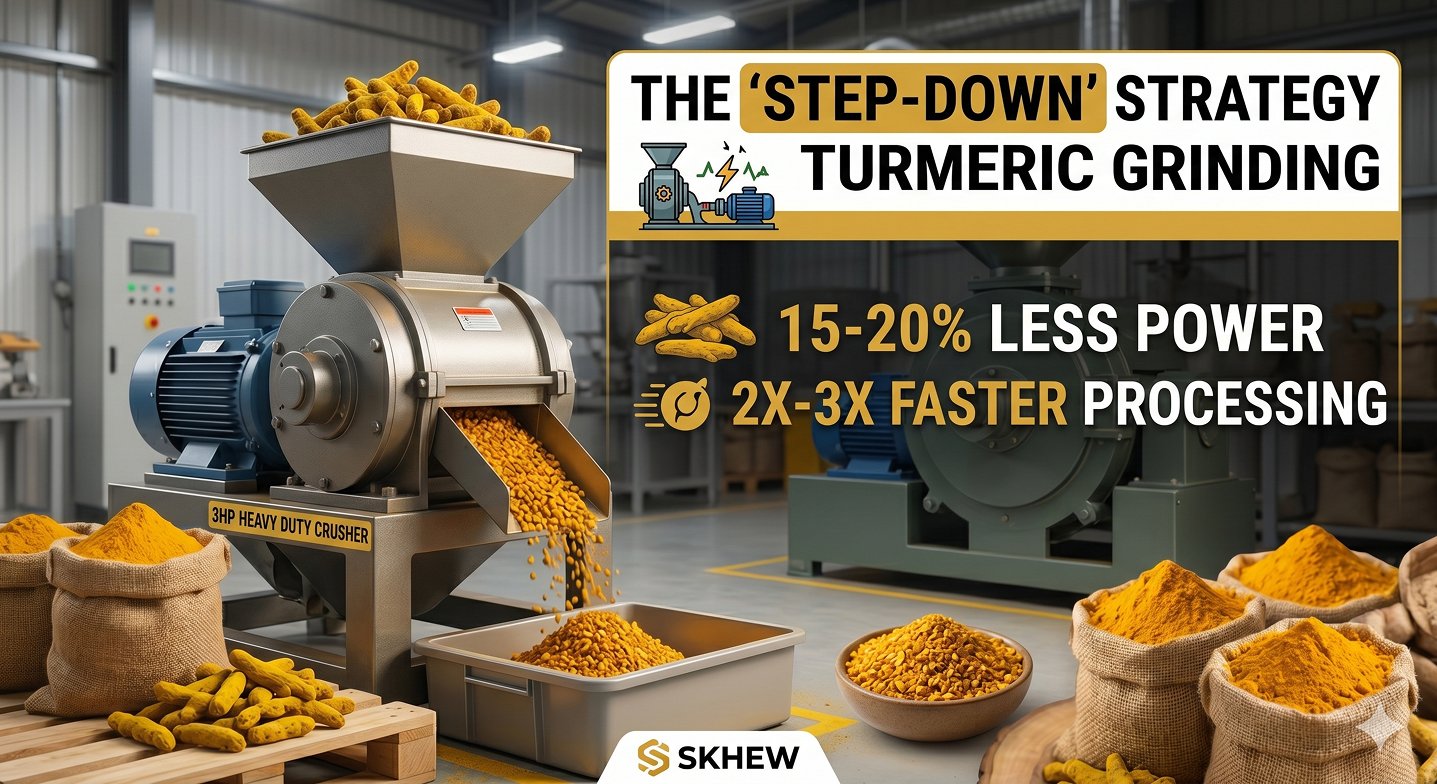
If you are running a commercial spice milling or processing plant, you already know that turmeric is one of the toughest, most stubborn materials to grind. Those rock-hard turmeric fingers can put a massive strain on your machinery.
But did you know that the way you feed your turmeric into your milling system could be draining your profits?
Many processors make the mistake of feeding whole, hard turmeric fingers directly into their high-horsepower, fine-grinding pulverizers. This practice doesn’t just spike your monthly electricity bills; it silently destroys your machinery.
At SKHEW, we engineer systems for maximum efficiency. Today, we’re sharing a simple engineering strategy that can cut your turmeric grinding power bills by 15% to 20% while drastically extending your equipment’s lifespan.
The Problem: The Single-Stage Grinding Trap
When a fine-grinding pulverizer attempts to pulverize a whole turmeric finger in a single pass, it has to work overtime.
The heavy, high-speed hammers or beaters hit the large, hard chunks, causing massive resistance. This results in:
- Peak Power Spikes: Your motor draws maximum current to break the initial resistance, leading to expensive peak-demand charges from your utility company.
- Severe Wear and Tear: Hammers, liners, and screens wear out at an accelerated rate.
- Heat Generation: Prolonged grinding friction heats up the turmeric, which can degrade its natural oils, color (curcumin content), and aroma.
The Solution: The “Step-Down” Strategy
The secret to industrial efficiency isn’t using a bigger machine—it’s using a smarter process. We recommend implementing the Step-Down Strategy.
Instead of forcing one machine to do all the heavy lifting, split the workload. Run your dried turmeric through a low-horsepower, heavy-duty crusher first. This initial stage quickly reduces the whole fingers into a uniform grit (roughly 2–5 mm in size) before it ever touches your main fine pulverizer.
Counter-Intuitive? Won’t running two machines use more power?
It is a common misconception. Plant managers often ask us: “If I am running two motors instead of one, won’t my electricity bill go up?”
The short answer is: No. It actually uses significantly less.
Here is the science and physics behind why the Step-Down Strategy works:
1. The Physics of Cracking vs. Pulverizing
Cracking a brittle, dried turmeric finger requires compressive or low-speed impact force. A low-speed, low-HP crusher handles this effortlessly because it isn’t trying to make powder; it is just fracturing the material. It consumes very little energy.
2. Massively Reduced Retention Time
Because your main fine pulverizer (which houses your largest, most power-hungry motor) is being fed a uniform 2–5mm grit instead of giant, irregular chunks, it doesn’t have to struggle. It processes the pre-crushed batch 2x to 3x faster.
3. Erasing the Energy Spikes
By eliminating the heavy impact resistance of whole fingers, your main pulverizer operates at a smooth, continuous load. This completely eliminates the costly peak power spikes that occur when the motor bogs down.
The Bottom Line Payoff
When you optimize your processing line with an SKHEW-approved pre-crushing stage, the benefits hit your bottom line immediately:
- Plunging Electricity Consumption: Shorter run times on your largest, highest-kilowatt machine mean your overall energy consumption (kWh) drops drastically.
- Increased Throughput: You can process double or triple the tonnage per day because the main mill isn’t choked by large materials.
- Drastically Lower Maintenance Costs: Hammer wear, screen tearing, and bearing fatigue drop significantly, saving you thousands in spare parts and maintenance downtime.
- Superior Product Quality: Faster processing means less heat buildup, preserving the vibrant color and essential oils of your turmeric.
💡 Join the Conversation
Want to stay ahead of the curve with more industrial milling insights, equipment optimizations, and energy-saving strategies? Join the PowderTech India community to connect with fellow processors, engineers, and industry experts sharing practical tips for the modern plant.
Upgrade Your Processing Efficiency with SKHEW
Stop letting hard materials chip away at your hard-earned profits. If you are looking to optimize your spice grinding line, reduce your carbon footprint, and lower your operational costs, it’s time to rethink your process.
Want to see how the Step-Down Strategy can fit into your current layout? [Contact the SKHEW Engineering Team today] for a custom consultation and let us help you grind smarter, not harder.